I know it’s not popular in the general VC narrative to pick a specific deity to attach their vampyric spiritual practice to. It’s more popular in the LHP to venerate a specific deity, spirit, or demon in connection to your vampyric nature. There’s no right way to feel about this, only personal perspectives and leanings.
For me personally though, Hekate has always been a driving force behind my craft. I revel in the chaos magic style of my witchcraft, but Hekate has always been the unchanging constant that leads my soul no matter where else I find connection or pick tools up from.
The Ides of Hekate are nigh! Soon comes the Hekatessia Festival.
August 13th is a Modern day of Hekate’s power with some ancient origins. The validity of its reverence today is contested by historic purists, but the modern current of Hekatean Witches have seized this day and ran with it. Who am I to shun something because it’s modern? As a vampyre especially, that would be silly.
Plus, this isn’t a wholly new holiday. In fact, August 13th’s Hekatean reverence begins in Ancient Rome. The Temple of Diana Nemorensis to be exact. That’s right, this Hekatean holiday doesn’t even start with Hekate… Or does it?
Diana of the Grove, Nemi – Mirror of the Moon
Diana Nemorensis aka Diana of Nemi or Diana of the Grove, was the subject of a Dianic Cult that called a lake in the crater of an extinct volcano home. Lake Nemi is a small circular volcanic lake in the Alban Hills of Rome in the Lazio region of Italy, once known as the Latin city of Aricia. The lake itself was formed in an ancient volcanic crater that was created at least 36,000 years ago.

They referred to the lake as the “Mirror of Diana” because of the way the water’s surface would reflect the moon at night.
Along the North Shore of the lake is where you will find the Temple of Diana Nemorensis.

During the Ides of August, also known as the Hekatean Ides, this cult of Diana Nemorensis would celebrate the holy days of Nemoralia. During Nemoralia, a procession of women carrying torches would walk from the Temple to Lake Nemi.

Once there, they would leave offerings to the Goddess and leave requests for aid, especially with healing.
In 1st century CE, the poet Statius wrote of Nemoralia:
It is the season when the most scorching region of the heavens takes over the land and the keen dog-star Sirius, so often struck by Hyperion’s sun, burns the gasping fields. Now is the day when Trivia’s Arician grove, convenient for fugitive kings, grows smoky, and the lake, having guilty knowledge of Hippolytus, glitters with the reflection of a multitude of torches; Diana herself garlands the deserving hunting dogs and polishes the arrowheads and allows the wild animals to go in safety, and at virtuous hearths all Italy celebrates the Hekatean Ides. (Statius Silv. 3.I.52-60)
You can see above that Statius refers to the “Hekatean Ides” despite this being a day for Diana. In some classical and later traditions, the Greek goddess Hekate and the Roman goddess Diana are conflated, particularly in their roles related to the night, the moon, the underworld, and magic.
Fun Fact: Did you know “the dog days of summer” means the time when the Sirius constellation is in the sky? It was believed that the “heat” of Sirius, rising alongside the sun, added to the sun’s heat, making the summer particularly scorching.
Anyways, Diana Triformis (triple formed) was conflated by some Roman poets with Hekate helped in part when statues of Diana were placed back to back at a crossroads. Diana is also equated with Artemis. One of Diana’s epithets was Trivia (“of the crossroads”) which, obviously, compares to Hekate. In the Homeric “Hymn to Demeter” Artemis is first described as a playmate of Persephone and perhaps reappears as Hekate, Demeter’s companion in the search for her stolen daughter. Hekatos (Far-Shooter); the masculine form of the name Hekate, was a common Homeric epithet for Artemis’ brother Apollon.
With that said, these deities are not all the same. They have some conflation between them and the syncretism between them started in Ancient times. Nevertheless, modern ideas of neat and complete overlap of these deities making them all one in the same are a bit off base and reductionist. Each deity, each epithet, each era and area in which they are called gives each of these beings different dominion, different power, different authority, and different beliefs and systems that surround them.
Now… Despite there being an ancient origin to connect to, the modern practice is not a continuation of Nemoralia. At least not one with a continual history that can be linearly traced. The practice was not kept alive all this time that I know of and if it was, the modern Hekatean Holiday or Sabbat ain’t it. The modern Festival of Torches is just that, modern… yet borrowing from antiquity as each modern cultus so chooses.

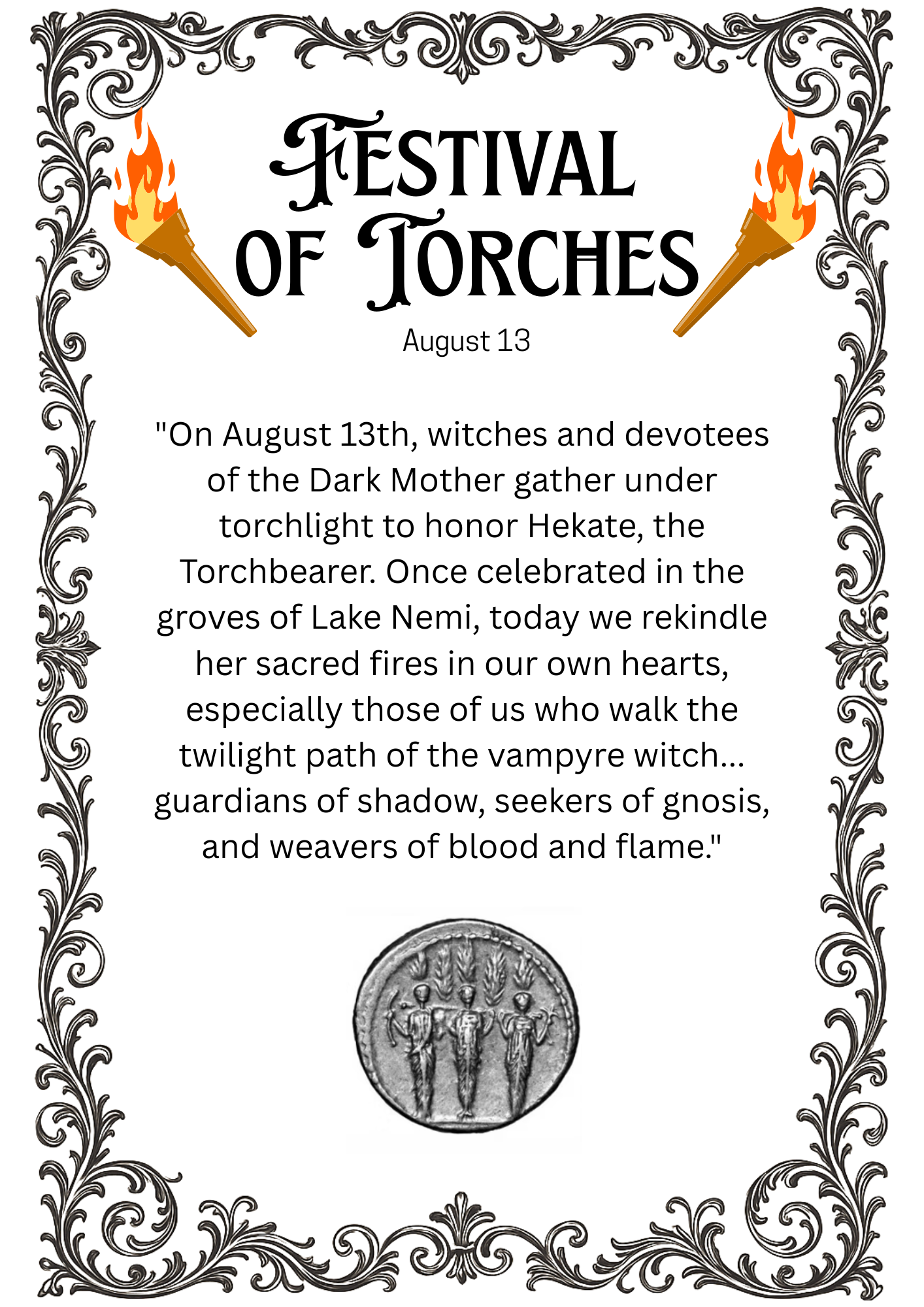
Ancient Roman Denarius depicting an image of the triple goddess. It is believed to be either Diana Nemorensis or Artemis/Selene/Hekate. Photo in Public Domain
The Modern Festival of Torches
“The Father snatched the fire from His power and entrusted it to Hekate.”
(Fragment 32 of the Chaldean Oracles)
The Father in this case? The primordial force of creation. The God before Gods. The Ineffable one. It is the transcendent source of all things. It is from this primordial kaos that the possibility of all creation is possible… and it is from this source, Hekate is entrusted with the power of his primordial divine fire.
Hekate is the ultimate torchbearer. She is known as the “Hieros Pyr” or the Sacred Fires that birth the cosmos. It is through her and her sacred fires that souls pass through into incarnation, and pass back through to the divine source. She holds the keys the unlock the gate for you to find your way to the underworld. She holds the torch so you can see your way down the path. She guides the way and lets you know when it’s time to make necessary sacrifice… and she will hold your hand as you take your first steps into the river of blood. The Festival or Torches is a celebration of our inner fire as well as a celebration of the torchbearers in our lives, both spirit and real.
We face trials and tribulations that become our teachable moments. Through perseverance we gain insight. We honor our passions and the things that set our soul ablaze. We remember our inner flame and we revel in it. We also hail the torchbearers that illuminate the way along our journey. We hail our guardians who guide us down the right path.
and then the Heavens cry tears of fire for us…
The Perseids meteor shower also happens to be at its peak during this time. Every year, the peak of this meteor shower hits on this date. The peak is a couple days before and after the 13th. Find a place with as little light pollution as possible to see from 50-100 shooting stars an hour. It’s a truly magical time of year if you’re in an area that’s able to see the stars. The moon is full on the 9th, so the light of the moon may drown out some stars at its peak. The meteor shower itself is happening now until the end of August though so take some time between now and then to look up at the night sky for a little while <3






Recent Comments